


Watch enthusiasts know that there is a lot more to a watch than its function of telling the time. A watch can be a work of art, a status symbol, and even an investment.
It is important to understand the terminology used in this industry so you can be sure you are getting the best deal on your new watch.
Here are some of the most common terms you will encounter when shopping for a new timepiece.
Watch Movement
Watch movement refers to how your watch works internally to keep time accurately. A movement can be mechanical (using physical parts) or quartz (powered by electricity).
1. Mechanical Watch Movement
The heart of any mechanical watch is movement. The term movement refers to the mechanism that powers the watch and keeps it running.
It includes the mainspring, gears, balance wheel, and escapement, which are collectively called “the movement” or “the caliber”.
Mechanical Movement
A mechanical watch movement can be either manual or automatic. Automatic movements are wound by the natural motions of the wearer's wrist, while manual watches require winding by hand.
Mechanical watch movements are generally hand-made and extremely complex. They contain parts that must be assembled with great precision to function properly.
Manual Winding
The user must periodically wind this type of movement by hand using a crown on the side of the case or backplate; this is not as common today due to its complexity, but can still be found on some vintage pieces or high-end luxury watches.
Automatic Movement
This refers to a mechanical watch whose mainspring is wound by the natural motion of the wearer’s wrist. Automatic movements require no battery.
This is in contrast to quartz watches, which gain power from an electronic battery that needs to be replaced every few years.
Automatic watches need to be worn at least once per day to keep them running. If you don't wear an automatic watch for more than 36 hours, it will stop working until you start wearing it again.
Related post: Best Automatic Watches Under $200
The main components of a mechanical watch movement include:
The Mainspring

The mainspring is the heart of a watch, and it's the key to understanding how a mechanical watch work.
It can be made of different materials including steel or titanium. A typical mainspring will not only power your timekeeping function but also store energy to drive the gear train, which moves the watch's hands and regulates the timekeeping.
Mainsprings come in different thicknesses; measured in millimeters, depending on their power reserve. The thicker they are, the longer they will last before they need replacing.
The mainspring is wound by hand, or automatically with an automatic winding mechanism.
The Gear Train

This is a series of gears that transmit power from the mainspring barrel to the escapement, which releases it gradually to keep time.
The gears are always connected together, so their teeth make contact with each other when they turn.
The Rotor

The rotor is a small weight that is attached to the inside of the movement. As you move your wrist, the rotor turns and winds up the mainspring, which delivers energy to run your watch.
The speed at which your rotor turns depends on how much energy you need from your watch's mainspring.
How Does It Work?
When you wear an automatic watch, it uses energy from your arm movements to wind up its mainspring by turning the rotor.
The more you move your arm, the more energy is stored in your watch's mainspring and will keep it running for longer periods of time without having to manually wind or wind it yourself by hand.
The Escapement

The escapement is one of the parts that make up a watch movement, along with the mainspring, balance wheel, rotor, and other componentHow Does Escapement Work?
The escapement is the device in mechanical watches that transfers energy from the mainspring to the gear train of the watch.
The energy is stored in the mainspring and released at regular intervals by the escapement to the balance wheel. In other words, the escapement controls the release of energy stored in a mainspring.
A mechanical watch needs to be wound regularly so that it can run; if it’s not wound, it will stop working within 48 hours or so.
In an automatic mechanical movement, this winding is done automatically by a rotor; the part which rotates inside the case, which turns as you move your wrist and winds up the mainspring as it does so.
The Balance Wheel

This is another watch terminology that you should be aware of if you are interested in owning one or several modern mechanical watches. The balance wheel is a crucial component of an automatic watch movement.
It oscillates back and forth causing the gear train to rotate. The gear train then powers the hands of the watch and its functions such as date.
Its oscillations are controlled by the escapement mechanism which releases energy from the mainspring at regular intervals.
2. Quartz Movement
Quartz Movement or Quartz watch is a type of electronic movement used in watches and clocks. The word comes from the Greek word quartz which means rock crystal.
A quartz watch uses tiny crystals that vibrate at a very high frequency to keep time accurately for years.
Quartz watches can also be made thinner than mechanical ones because they don't have any moving parts inside them.
Quartz watches use a battery as their source of power instead of winding up a spring-like in a mechanical movement. Quartz watches are cheaper than mechanical ones.
The Quartz Crystal
This is a piece of quartz that oscillates at a very precise frequency. The frequency at which the crystal vibrates determines the timekeeping accuracy of the watch.
The quartz crystal is connected to a battery that supplies it with an electric current that keeps it vibrating at a constant rate. This electric current is used to run the watch and keep it synchronized with official time sources.
The Quartz Crystal is enclosed in a sealed cavity within the case back where it is protected from dust and moisture.
Battery
A quartz watch uses a battery to power its movement. The battery is located in the back of the watch, and it is often removable.
The battery supplies electricity to the quartz crystal, causing it to vibrate at a precise rate. This causes the watch hands to move around the face of the watch at exactly one-second intervals.
You might be also interested in Difference Between Quartz and Automatic Watches, make sure you check it!
A Watch Case

This is another watch terminology that you should be aware of. A watch case is the outer casing of the watch.
Cases can be made from various materials such as gold, steel, plastic, and titanium. A watch case can come in many different styles including round, rectangular and square shapes.
Case sizes also vary depending on the style and brand of the watch. Some cases are transparent or have windows on them so that you can see the movement inside called skeleton or open-dial watches.
Watch Terminology-Crown

A button located on the side of a watch is used to adjust the time or set certain functions in some watches.
You typically use your index finger to pull out or push this button when adjusting the time and sometimes other functions such as alarms or changing modes for example from analog to digital.
Watch Crystal
The watch crystal is the transparent cover that protects the watch face. It can be made of glass, plastic, or sapphire.
The quality of the crystal will largely depend on the price of the watch, as well as it is brand.
Sapphire
Sapphire crystal is a crystal that is only used on expensive watches. It's made from sapphire, which is one of the hardest materials known to man.
Sapphire crystals are also scratch-resistant, which makes them an ideal choice for a luxury timepiece.
Synthetic Ruby
Another type of crystal that is used in some high-end wristwatches is called "synthetic ruby".
This material is also very hard and scratch-resistant but has the added benefit of being able to change color depending on the light source shining through it.
In fact, this property is exploited by many watch companies to make the hands and numbers appear black or white depending on how much light they receive.
Glass
Glass is the most commonly used material for watch crystals. It is relatively cheap and easy to manufacture, but it can be easily damaged if mishandled or dropped.
It is a clear and transparent material that allows you to see the movement of your watch.
Another downside of glass is that it scratches easily, which can be seen as a disadvantage for some people. However, if you take care of your watch properly, crystal glass will last you for years.
Watch Dials
The watch dial is part of a watch face that displays time, date, and other information using hands or markers.
It can have decorative gems or stones set into it or contain markings that show time zones or degrees of temperature.
Dial Material
Most dials are made of stainless steel, but they can also be made from gold, ceramic, or titanium.
The type of material used depends on what type of watch is being made and how much money you want to spend on a watch.
The word "dial" comes from the Latin "diaulus," which means "circle." This makes sense because most watch faces have circular shapes and have no edges or spokes like those found on clocks or other timepieces.
Analog Watch Dial

Analog watches are the most common type of watch with a face that displays hours, minutes, and seconds through hands that move around the dial.
Analog watches can also have subdial or subdials (smaller dials) that display additional information like the date or day of the week.
Digital Watch Dial

A digital watch uses numbers rather than hands to display time. Digital watches may have additional features like alarms, stopwatches, and timers, but they generally don't show as much information as analog watches do.
The hour and Minute Hands
Parts of a dial that move around its perimeter to display time in hours and minutes (and sometimes seconds).
They may be colored differently depending on whether they indicate hours or minutes. For example, red hands indicate hours while white hands indicate minutes.
ETA-Largest Watch Movement Maker
ETA is a Swiss manufacturer of watch movements and is based in Switzerland. The company was founded by a group of watchmakers.
ETA movements are used by many well-known watch brands including Longines, Tudor, Omega SA, Rado, and Tissot.
In recent years, ETA has been producing its own line of luxury wristwatches under the brand name "ETA" as a way to enter the higher-priced market segment with its own brand name rather than supplying other brands with movements.
A Watch Winder

A watch winder is a small device that keeps an automatic (self-winding) watch running when it isn’t being worn.
It does this by moving the watch around in its case so that it can be wound by its internal spring mechanism.
This means that even if you aren’t wearing your watch for several days or even weeks at a time, it will still be fully functional when you do put it on again.
They are particularly useful if you have multiple watches and want to be able to quickly put them on without having to manually wind them every day.
Water Resistance
Water-resistance is one of the most important features of a watch. Water Resistance is the term used to describe a watch's ability to resist water, as well as its ability to withstand pressure.
It is measured in units of the atmosphere (ATM), which indicates the depth at which a watch can be safely submerged. Increasing numbers refer to greater depths.
The higher the number of meters, the more water-resistant the watch is. So a watch that says "5 ATM" can be worn while swimming or snorkeling but not diving.
A Diver's Watch

A watch that says "50m" can be worn while swimming, snorkeling, or diving to a depth of 50 meters.
A diver's watch is a type of watch designed for underwater use, including scuba diving and snorkeling.
A good diver's watch will also have some form of luminescence on the hands, and a dial to aid in reading the time in dark conditions.
The bezel of A Watch
The bezel of a watch is the ring that surrounds the watch's face. It can be fixed or rotating. The word comes from the French word biseau, which means "chisel."
The most common material used to make bezels is metal. They're also made from ceramic, glass, plastic, or precious stones like diamonds and sapphires. Bezels can be plain or decorated with jewels or other materials.
Bezels are used to protect the watch face, as well as to improve its appearance by adding color or texture.
Complication
A watch complication is a specific feature that can be added to a watch.
Most complications are not essential, but rather are intended to add interest to the watch's design or make it easier to read.
The term "complication" encompasses all functions of a watch other than timekeeping, including calendar displays, power reserve indicators, and chronograph functions.
When it comes to watches, there are many different types of complications. Here are some of the most popular ones:
Alarm
An alarm is a feature that sounds at a set time to alert you that it's time to wake up, eat lunch or go to work. Most modern watches have alarms that can be set from one minute to 12 hours in advance.
Calendar
The calendar complication shows the date and day of the week on a watch face. It is a great feature if you want to know what day it is and when your next appointment or meeting is.
Moonphase
This feature lets you know what phase the moon is in at any given time of day. Mechanical watches with moon phases will be used to predict the tides, which can be useful if you are planning a beach vacation.
Tachymeter
A tachymeter measures speed over a known distance, useful for measuring car speeds or determining how many miles per hour you're traveling on foot (or bike). Tachymeters are usually found on chronographs but some single-hand watches have them too.
Chronograph
Chronograph watches are often referred to as "chronos" or "timers." A chronograph watch features a stopwatch function that can be used for timing events like sports or races.
A chronograph watch usually has three hands: one for the seconds, one for the minutes, and one for the hours. Some chronographs also include a fourth hand that indicates a 24-hour time display.
The chronograph was invented by Louis Moinet in 1816, and later in 1883, Henri Rackemann perfected it. The technology quickly caught on and has been popular ever since.
Chronometer
The term chronometer is a general term for any accurate timekeeper, but it's most commonly used to refer to wristwatches that have been officially certified by the Contrôle Officiel Suisse des Chronomètres.
Chronometer watches are certified by the Contrôle Officiel Suisse des Chronomètres (COSC). The certification process requires the movement to be tested over several days.
The testing process is so rigorous that not all watches submitted pass.
Power Reserve
The power reserve is the amount of remaining power in a watch. The power reserve is measured in hours, minutes, and seconds. It can be shown on a dial or in the sub-dial.
This feature is useful as it shows the power that has remained in your watch's battery or movement after it has been fully wound. Most automatic watches have power reserves of 40 hours or more.
Power Reserve Indicator
This is a feature in mechanical watches that shows how much power remains in the mainspring and barrel.
It may also be called Reserve de Marche, Réserve de Marche or Réserve de Temps, depending on the brand.
The power reserve indicator can be in different forms; a hand showing the remaining time, an arrow that moves around a scale, or a cylinder with hours marked on it.
Watch Bracelet and Strap

There are different kinds of straps or bracelets that are used in watches. The most common ones are leather, rubber, and metal.
Leather straps: Leather straps are the most common type of straps. They come in many colors and textures and can be used with both casual and dressy watches.
Metal straps: Metal straps have become increasingly popular in recent years as they are durable.
Rubber straps: Rubber straps were once only seen on diver's watches but now they can be found on many different types of watches from sports-themed models to more formal designs.
It is worth noting that a watch strap has a buckle closure at one end so it can be easily adjusted to fit any size wrist.
The metal buckles as well as silver, gold, or platinum buckles depending on the style you choose for your watch band.
Pocket Watches
Pocket watches are the oldest type of watch and were invented in 1510 by Peter Henlein. Unlike other types of watches, pocket watches are usually attached to a chain that is carried around the neck or waist.
They were made popular by sailors and travelers since they could be easily transported without being damaged during travel.
A Skeleton Watch
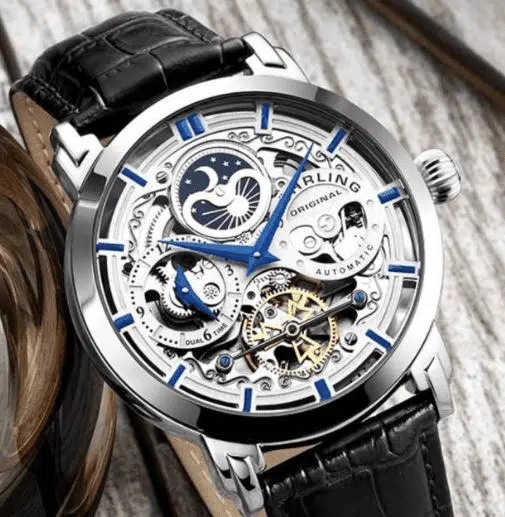
This is a type of watch that has the movement exposed, so you can view it from the front and back.
The name comes from the fact that many of these watches have an open-top plate, which exposes the inner workings of the watch.
The idea behind this style of watch is that every element of its design can be seen in order to show off its inner workings and make them more accessible to people who are interested in them.
World Time Watch
A world time watch is a watch that has the ability to display the time in multiple time zones.
A world time watch is perfect for those who travel frequently or live in multiple time zones. With one look at your wrist, you can see what time it is back home and in any other part of the world.
This makes it easier for you to keep track of the time zones where friends and family are located so that you can call them without worrying about waking them up at an inconvenient hour.

- SEIKO Pilot Chronograph Review - April 14, 2023
- Citizen Eco-Drive Brycen Chronograph Review - April 14, 2023
- Analog Watch vs Chronograph Watches - January 31, 2023
